Which Search Terms Actually Belong to Your Facility?
A look at how addiction treatment searches divide by level of care — and why targeting the wrong ones wastes budget and misses patients who are ready to call.
A detox center and an intensive outpatient program are both addiction treatment facilities. They both want to appear when someone searches for help. But the searches that lead to a detox admission and the searches that lead to an IOP enrollment are almost entirely different conversations.
This is the problem most addiction treatment marketing gets wrong. The keyword list gets built from the top down — “drug rehab,” “addiction treatment,” “rehab near me” — and every facility in the organization targets the same pool regardless of what they actually offer. The result is wasted ad spend, confused landing pages, and a patient who clicked expecting residential care and found an outpatient enrollment form.
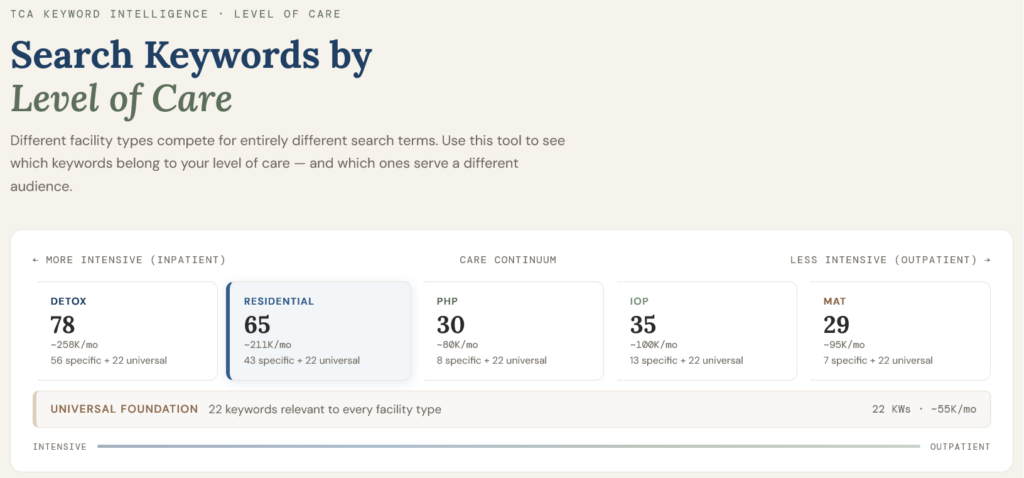
We built a tool to make this visible. The Addiction Treatment Keywords by Level of Care interactive map lets you filter 115 keyword phrases by the level of care they actually serve, see monthly US search volumes, and identify which terms are exclusive to your program type — and which ones you’re fighting for unnecessarily.
Here’s what the data shows.
—
The Scale of the Search Market
More than 220,000 searches happen every month in the United States for addiction treatment-related terms — and that figure comes from a conservative set of under 90 tracked keyword phrases from Semrush. The real number, accounting for medication-assisted treatment queries, sober living searches, and awareness-stage terms like “how to stop drinking,” likely reaches 400,000 or more monthly searches when the full landscape is mapped.
But raw volume is deceptive in this space. A single treatment-seeker often generates multiple searches in the same session — “detox near me,” then “alcohol detox,” then “same day detox.” These are recorded as three separate searches but represent one person. After accounting for that session overlap, the true pool of unique treatment-seeking individuals in the US is likely closer to 150,000–200,000 per month.

That’s still a substantial market. It’s also a highly competitive one, with major aggregators, directories, and well-funded multi-site operators occupying much of the visible search real estate. Which is exactly why precision matters more than volume.
Detox: The Largest — and Most Specific — Keyword Pool
Detox facilities have access to the largest exclusive keyword pool of any level of care: 27 terms that belong almost entirely to them, representing roughly 73,000 monthly searches. Add the terms shared with residential programs and the universal baseline, and a detox-focused facility has a relevant universe of around 78 keyword phrases and 258,000 monthly searches.
The exclusive detox terms are urgent and specific. “Same day detox.” “Immediate detox admission.” “Detox with beds available.” “Medical detox.” “Detox that accepts insurance.” These are searches made by people in crisis or by family members managing one — they are not comparison shoppers. They need a response in hours, not days.
Substance-specific detox terms — “fentanyl detox,” “benzo detox,” “meth detox,” “xanax detox,” “opioid detox” — also belong almost entirely to this category. No outpatient program should be competing for these. No residential facility without on-site medical detox should be bidding on them either.
What detox facilities do *not* need to target: “residential treatment,” “inpatient rehab,” “IOP program,” or anything in the PHP/outpatient space. Those searches are looking for something different.
—
Residential: Sharing Space With Detox, Owning Its Own Territory
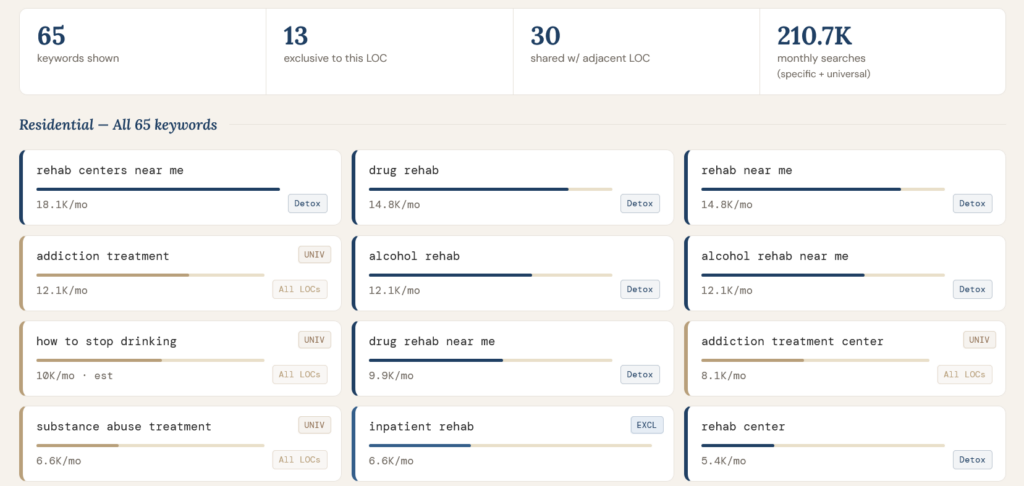
Residential programs share a significant portion of their keyword universe with detox facilities — terms like “drug rehab near me,” “alcohol rehab,” “rehab centers near me,” and “cocaine addiction treatment” are relevant to both, because many searchers at this stage haven’t distinguished between the two.
But residential programs own exclusive territory that detox doesn’t: “inpatient rehab,” “residential treatment center,” “residential drug rehab,” “executive rehab,” “luxury rehab,” and “private rehab.” These terms signal a searcher who has moved past crisis and is evaluating options — a very different conversation that calls for a very different landing page.
The “luxury” and “executive” rehab terms carry meaningful volume (4,400 and 880 monthly searches respectively) and extremely high commercial intent. A facility with premium positioning that isn’t appearing for these terms is leaving significant opportunity unrealized.
—
PHP and IOP: Clean Separation, Underappreciated Volumes
Partial hospitalization and intensive outpatient programs are often lumped together in marketing discussions, but their keyword pools, while adjacent, are meaningfully different.
PHP’s exclusive territory centers on “partial hospitalization program” — 8,100 monthly searches, all of them from people who know what PHP is and are actively seeking it. That level of specificity is valuable. Combined with “php near me,” “php rehab,” and “php addiction treatment,” this is a focused pool of high-intent searchers.
IOP’s exclusive territory is larger and more broadly recognized. “Intensive outpatient program,” “iop program,” and “iop near me” together account for nearly 28,000 monthly searches — all exclusively IOP-relevant. Two emerging terms worth noting: “virtual IOP” (1,900/mo) and “evening IOP” (260/mo) have lower competition than the primary terms and serve a real and growing segment of patients who need flexibility.
An IOP-only program has no business targeting “detox near me” or “inpatient rehab.” Those searchers are looking for a level of clinical intensity that outpatient cannot provide. Appearing in those results wastes budget and creates a mismatch that damages trust.
MAT: An Entirely Separate Search Ecosystem
Medication-assisted treatment operates in its own search universe with almost no overlap with any other level of care. “Suboxone near me” (12,000/mo), “methadone clinic near me” (10,000/mo), “suboxone clinic near me” (8,000/mo), and “suboxone treatment” (5,000/mo) are searches made by people with a specific, clinical need. They are not browsing rehab options. They are looking for a prescriber.

A suboxone clinic that targets “rehab near me” is spending money to appear in front of people who are not their patient. A residential program that ignores MAT terms is missing an adjacent, high-intent audience — particularly relevant if the facility offers MAT as part of its programming.
These terms are entirely absent from most addiction treatment keyword strategies we see. That’s a gap worth examining.
—
The Universal Foundation: Terms Every Facility Should Target
Regardless of level of care, every addiction treatment facility should compete for a core set of universal terms. These are searches that don’t specify a treatment modality — they represent people at the beginning of their search, or family members trying to understand options.
“Addiction treatment,” “substance abuse treatment,” “addiction treatment center,” “how to stop drinking,” “intervention services,” “help for addicted son” — these are top-of-funnel queries with high reach and meaningful intent. They’re also where brand-building happens, where trust is established before a prospective patient or family member ever picks up the phone.
The insurance-match queries in this category (“rehab that accepts insurance,” “in network rehab”) are lower volume but extremely high intent — someone this specific about insurance has already made the decision to seek treatment.
—
How to Use This
The interactive tool lets you click any level of care and see the full keyword list with monthly volumes. The filter buttons narrow to terms exclusive to that LOC, terms shared with adjacent programs, or the full relevant set. Sort by volume to see where the search demand concentrates, or sort by “exclusive first” to identify your most defensible territory.
Click here to view and use the tool.
A few practical ways to use it:
For content strategy — exclusive terms become page targets. Each exclusive keyword cluster points to a landing page your site should have.
For paid search — shared terms between detox and residential belong in separate ad groups with distinct landing pages. A searcher clicking “alcohol rehab” and arriving at a page about outpatient programming is a missed opportunity.
For competitive analysis — the terms your competitors rank for in Google Search Console, filtered against this map, will tell you immediately whether they’re positioning correctly for their LOC or competing broadly and inefficiently.
For pitch decks and strategy reviews — this data provides a structured way to explain keyword targeting to clinical leadership who may not understand why a detox program shouldn’t be bidding on IOP terms.
A Note on the Data
All volumes reflect US monthly Google searches based on Semrush keyword data collected in May 2026, supplemented with Google Keyword Planner data for terms not appearing in Semrush. MAT-related volumes are estimated based on industry benchmarks and are marked accordingly in the tool. Session-overlap deduplication has been applied to near-identical keyword pairs (“X” and “X near me”) where the searcher pool is estimated to be significantly shared.
This is a working dataset, not an exhaustive one. There are regional terms, payer-specific queries, and substance-specific phrases not represented here that may be significant for your specific market.
—
Have a keyword we missed? Working on a campaign where you’d like to use this data? Looking for a version filtered to your state, metro area, or program type?
Contact us — we review every suggestion and can build custom keyword analysis for specific markets.
—
Treatment Center Agency helps addiction treatment facilities and behavioral health organizations build marketing systems that are compliant, measurable, and built for the long term. Book a call to talk through your program’s keyword strategy.